

You can start guest posting as a digital marketing intern even with zero track record by targeting smaller, relevant blogs first, building quick “micro‑credibility,” and sending highly personalised, value‑focused pitches that closely match each site’s style and guidelines.
Below is a practical, low‑fluff game plan you can execute over the next 2–4 weeks.
1. Pick your “starter niche” and positioning
As an intern, you don’t need to be a broad “digital marketing expert.” Choose 1–2 narrow angles where you can speak from real experience or learning:
- Examples of intern‑friendly angles:
- “Beginner‑friendly guides” (e.g. how to set up UTM tags, simple GA4 reports, basic keyword research).
- “What I learned helping run [type of campaign] with a small budget.”
- “Step‑by‑step” how‑to content for tools you actually use.
Editors care about useful, clear content, not job titles.
2. Build quick “micro‑credibility” in 1 week
Before pitching, give yourself something to show:
-
Publish 2–3 solid posts on LinkedIn or Medium
- 800–1,200 words.
- Practical, step‑by‑step, with screenshots if possible.
- This becomes your “writing samples” in pitches.
-
Optional but powerful: publish 1 post on your agency’s blog or a school/club blog if you can. Even one URL on a “real” site makes you look less like a complete beginner.
You’re not doing this for traffic; you’re doing it so you can say:
“Here are 2 articles I’ve written on similar topics so you can see my style.”
3. Find realistic sites that might say “yes”
With no track record, skip the giant blogs at first. Aim for:
- Small–mid digital marketing blogs
- Niche business or startup blogs
- Local or regional marketing agencies with blogs
Ways to find them:
- Search patterns like:
“digital marketing” + “write for us”“content marketing” + “guest post guidelines”
- Use guest post directories or lists that show sites accepting contributions.
- Check agency blogs (many accept guest posts to keep content flowing).
Prioritise sites that:
- Clearly say they accept guest posts.
- Have guidelines (shows they’re used to contributors).
- Publish how‑to, educational content, not just company news.
Create a simple spreadsheet with:
- Site name
- URL
- Contact / editor email
- Guest post guidelines link
- 3 best‑performing articles (by topic/engagement)
4. Study each blog like an exam
Your edge (as an intern) is preparation.
For each target blog:
- Read 5–10 recent posts.
- Note:
- Typical word count.
- Format: listicles, guides, case studies, checklists.
- Tone: formal vs conversational, use of humour, level of detail.
- Audience level: beginner / intermediate / advanced.
- Linking rules from their guidelines (how many links, no affiliate, etc.).
You want your pitch and draft to feel like they already belong on their blog.
5. Choose topics that are easy “yes” for editors
Editors hate generic, overused topics like “What is SEO?” or “Why content marketing is important.”
Instead, pitch:
- Specific, practical, how‑to angles, for example:
- “A step‑by‑step guide to setting up UTM tracking for TikTok campaigns”
- “How to write Google Ads copy when you only have a S$500 budget”
- “A beginner‑friendly workflow for competitor keyword research in 60 minutes”
- Topics that fill a gap in their existing content:
- If they have “Beginner’s Guide to Email Marketing”, propose
“How to Write Your First 5‑Email Welcome Sequence (With Templates).”
- If they have “Beginner’s Guide to Email Marketing”, propose
You can identify gaps by scanning their categories and noting what isn’t covered in detail.
6. Pre‑write one outstanding draft (before pitching)
Because you have no track record, one way to stand out is to do more work upfront.
- Pick your strongest topic idea.
- Write the full article following best practices:
- 1,500+ words if that matches their usual length, but no fluff.
- Clear structure with 4–6 sections and descriptive sub‑headings.
- Simple, clear language with concrete steps and examples.
- Data/statistics where relevant (with references).
- Zero obvious self‑promotion; focus on teaching.
- End with a short CTA for comments or action, not for your services.
This draft becomes your sample when pitching multiple similar blogs.
7. Write a tight, personalised outreach email
Personalisation and professionalism are critical, especially when you’re unknown.
Use this structure:
-
Subject line ideas:
Guest post idea: [Specific Title]Guest article proposal for [Blog Name]: [Benefit‑driven topic]
-
Email body (template you can adapt):
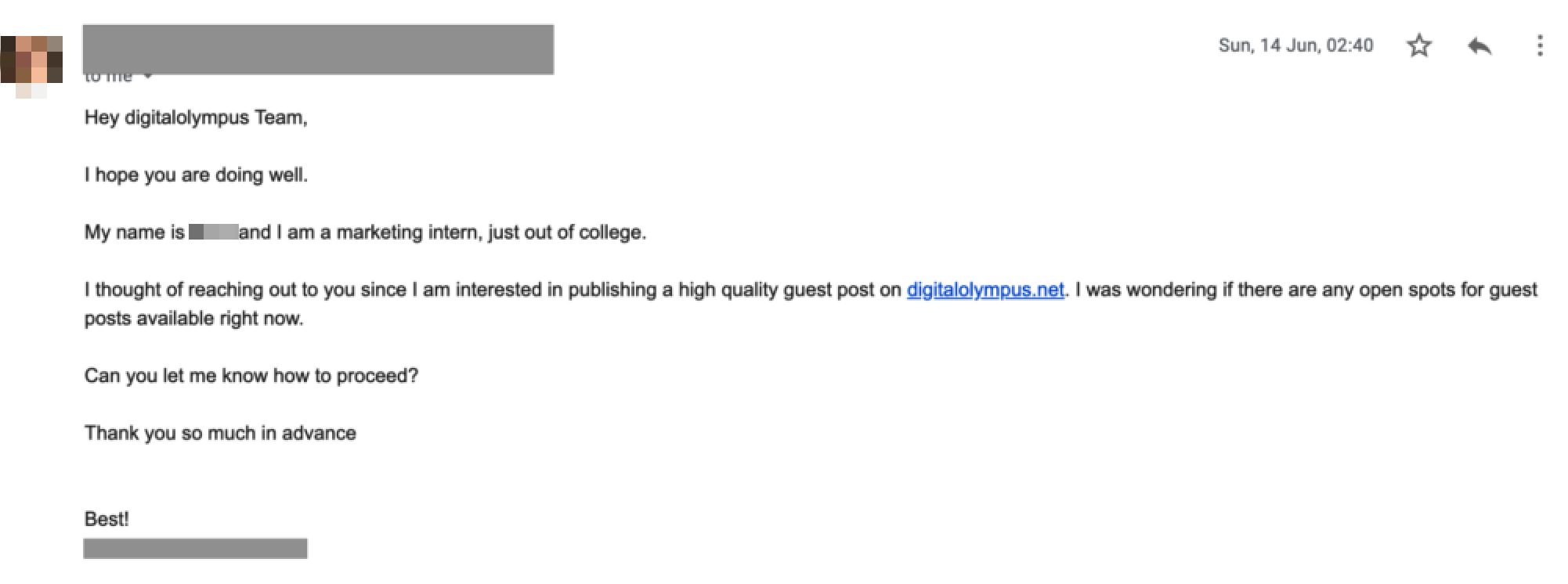
Hi [First Name],
I’m a digital marketing intern at [Company/University], and I’ve been following [Blog Name]—I especially liked your post on [specific article + short reason].
I’d love to contribute a practical, step‑by‑step guest article for your readers. Here are a few ideas tailored to your audience:
- [Title 1] – 1–2 sentence summary of the benefit.
- [Title 2] – 1–2 sentence summary.
- [Title 3] – 1–2 sentence summary.
To give a sense of my writing style, here are a couple of samples:
- [Article title] – short description
- [Article title] – short description
I’ll follow your guidelines closely and keep the focus purely on helping your readers, not promoting myself or my company.
If you’re open to it, I can send a detailed outline or a full draft for your review.
Best,
[Name]
[Role: Digital Marketing Intern at X]
[LinkedIn]
Key points:
- Show you’ve read their content.
- Emphasise value for their readers, not backlinks.
- Mention you’ll follow guidelines carefully.
- Offer to send an outline or draft (reduces editor risk).
8. Follow up politely (without being annoying)
If you hear nothing:
- Wait 5–7 days, then send a short follow‑up:
Hi [Name], just checking in on the guest post ideas I sent last week.
Happy to adjust topics or send a detailed outline if that’s easier.Thanks for considering,
[Name]
If still nothing after a second follow‑up a week later, move on to other sites.
9. Deliver like a pro once you get a “yes”
When a blog accepts your idea:
- Re‑read their guidelines so you don’t miss anything on:
- Word count, formatting, headings.
- Link rules and bio.
- Adapt your draft to their style:
- Tone and level (beginner vs advanced).
- Internal links to their existing posts where relevant.
- Add:
- A short author bio focusing on what you do and who you help.
- A profile photo if requested.
- After publishing:
- Share the post on LinkedIn/other platforms and tag them.
- Respond to comments to keep engagement high.
Editors remember contributors who bring traffic and discussion, which increases your chance of being invited back.
10. Turn one success into a track record
Once you have your first guest post:
- Add it to a simple portfolio (Notion, Google Doc, or personal site).
- Mention it in future pitches:
- “I’ve previously written for [Site Name] on [Topic].”
- Refine what works:
- Track which pitch subject lines and topic types get responses.
- Double‑down on those patterns.
After 2–3 successful guest posts on smaller sites, you can start aiming at larger, better‑known digital marketing blogs, using those links as proof of your credibility.
If you want, share your niche and one or two tools/campaigns you’ve actually worked on, and I can draft 3 concrete guest‑post titles plus a ready‑to‑send pitch email you can copy‑paste.















WebSeoSG offers the highest quality website traffic services in Singapore. We provide a variety of traffic services for our clients, including website traffic, desktop traffic, mobile traffic, Google traffic, search traffic, eCommerce traffic, YouTube traffic, and TikTok traffic. Our website boasts a 100% customer satisfaction rate, so you can confidently purchase large amounts of SEO traffic online. For just 40 SGD per month, you can immediately increase website traffic, improve SEO performance, and boost sales!
Having trouble choosing a traffic package? Contact us, and our staff will assist you.
Free consultation