

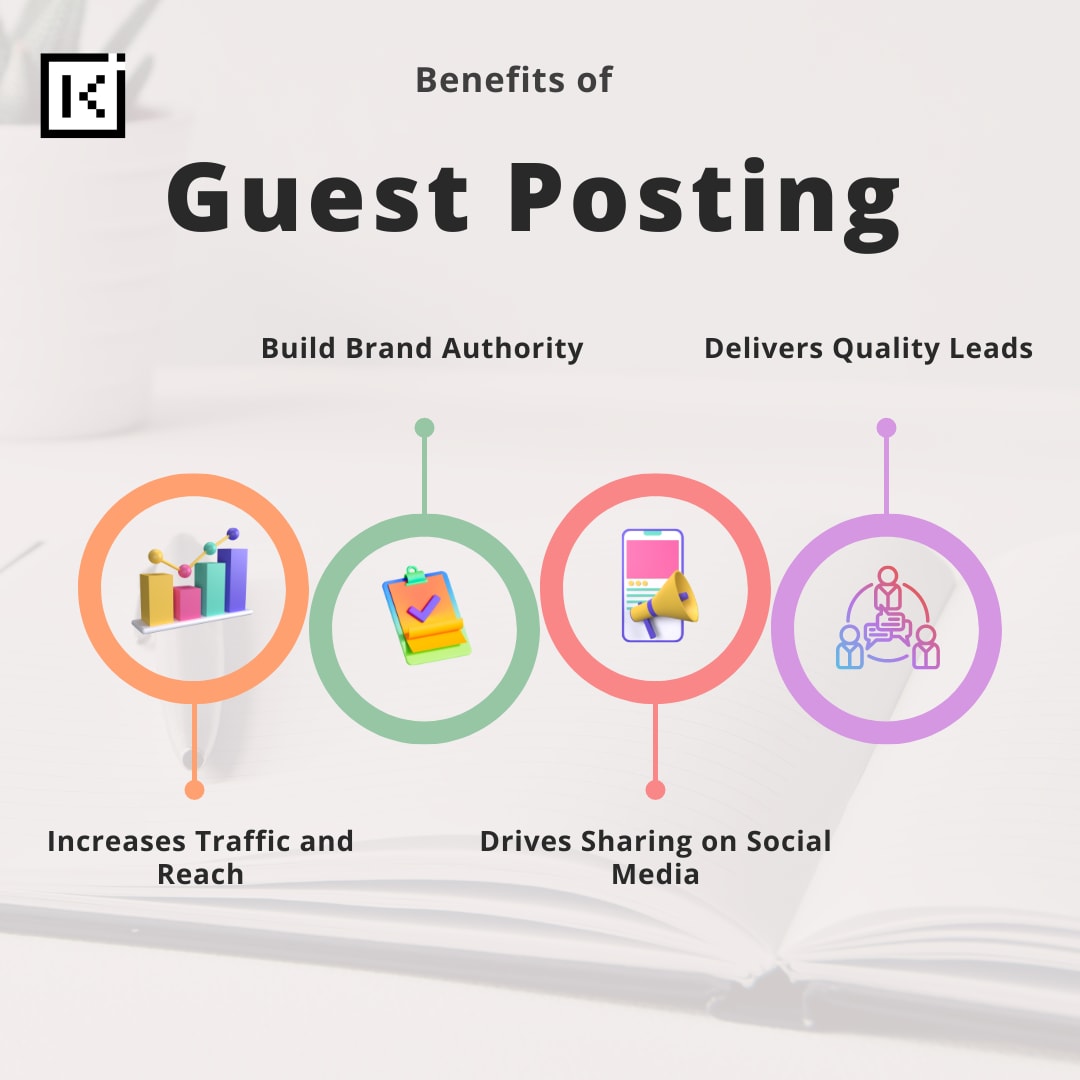
Advanced guest posting builds brand authority when you treat it as a thought‑leadership and relationship channel, not just a link‑building tactic. Below are advanced, brand-authority focused tactics you can use.
1. Define an Authority‑First Guest Posting Strategy
- Clarify authority goals
Decide what “authority” means for you: being known for a specific framework, methodology, niche specialisation, or category leadership (e.g. “the go‑to B2B pricing strategist”). - Map topics to your positioning
Build a topic map with 3–5 pillar themes that you want to “own” in your space and only pitch topics that reinforce those pillars, even when guest sites are broad. - Treat guest posts as editorial mentions, not link drops
Leading agencies in 2026 emphasise real editorial relationships, topical relevance, and brand building over volume. This is the same mindset you should adopt.
2. Advanced Prospecting: Find Sites That Grow Authority (Not Just DR)
- Competitor link intersection analysis
Identify sites that link to multiple competitors but not to you; they’re pre‑qualified, niche‑relevant outlets whose editors already publish your kind of content. - Topical + audience fit over raw metrics
Aim for sites with:- Strong topical relevance to your niche (Google and modern AI systems weight relevance heavily).
- Real traffic and engagement (comments, social shares, newsletter).
- Go beyond “write for us” pages
Use data‑driven tools or AI to surface non‑obvious opportunities where your audience already spends time, not just blogs openly soliciting guest posts. - Mine social media and author footprints
- Use X/LinkedIn search for “[keyword] guest post” or “[keyword] contributed by” to find sites actively publishing external experts.
- Reverse‑image search the headshots of prolific guest authors in your niche to discover where they contribute.
3. Pitch Like a Specialist, Not a Generic Contributor
- Lead with your unique angle / IP
Editors prioritise expert voices and proprietary insight. In your pitch, highlight: research you’ve done, frameworks you created, or notable outcomes (e.g. “helped X reduce CAC by 32% with Y framework”). - Propose system‑based or framework content
Content that explains a repeatable system or methodology has higher perceived value than loosely related tips and is more likely to be accepted and remembered. - Use data‑backed topic ideas
- Pitch articles based on original data, surveys, or analysis; these show genuine expertise and often get significantly higher acceptance rates than pure opinion pieces.
- Align with trending topics your host site’s audience cares about (use tools like Exploding Topics / keyword trend analysis).
- Customise every pitch to the publication
Reference specific articles they’ve published, suggest complementary topics, and show how your piece deepens their existing content rather than duplicating it.
4. Write Guest Posts That Signal Real Authority
To maximise brand authority, each post should make a reader think: “This person clearly knows their stuff.”
- Go deep and be non‑generic
- Use specific numbers, processes, screenshots, and examples instead of clichés.
- Share what didn’t work and how you iterated; this demonstrates experience, not theory.
- Use original data & case studies
- Incorporate proprietary data sets, campaign outcomes, or anonymised client case studies.
- Convert your own experiments into “mini‑studies” (e.g. AB tests, pricing experiments, funnel changes).
- Teach a clear, named framework
Introduce branded frameworks (e.g. “The 3‑Layer Demand Gen Model”) and reuse them across multiple guest posts to build recognition over time. - Optimise for both humans and search
Advanced teams now use AI tools for:- Readability analysis to match the host site’s style.
- Semantic optimisation to cover related concepts and entities comprehensively.
- Structural recommendations for engagement (subheads, bullets, internal mini‑CTAs).
5. Use Author Bios & Internal Hooks to Build Authority (Not Just Clicks)
- Craft a positioning‑rich author bio
- Emphasise your specific niche and proof (e.g. “B2B SaaS pricing strategist who has helped 40+ Series A–C startups” vs “digital marketer”).
- Include one primary authority asset: a flagship guide, research report, or playbook—not a generic homepage.
- Create a “Guest Post Hub” on your site
- Central page aggregating your guest posts, podcast appearances, quotes, and research.
- Link to this hub from your author bios to reinforce your expert status and give editors/social sharers a reference point.
- Subtle in‑content authority cues
- Mention your experience naturally in examples (“In a recent campaign we ran with a regional fintech…”).
- Reference your own frameworks and studies as sources without overselling.
6. Build Ongoing Editorial Relationships (Compounding Authority)
- Treat every successful guest post as the start of a relationship
- Propose a content series or follow‑up pieces that expand on your first article.
- Offer to update or co‑author strategic pieces (e.g. annual trend reports).
- Collaborate beyond blog posts
- Suggest joint webinars, AMAs, or newsletter takeovers with the publication’s team to deepen perceived authority.
- Shift from “guest author” to “regular columnist”
Long‑term recurring contributions on a small number of respected platforms build more authority than one‑off posts scattered everywhere.
7. Align with Google‑Safe & Future‑Proof Practices
- Prioritise compliance and editorial integrity
- Avoid link schemes, PBNs, or low‑quality farms; focus on white‑hat, editorial placements.
- Ensure each guest post is truly unique, with fresh examples and structure (no spinning or light rewrites).
- Anchor text & link strategy for credibility
- Use natural, context‑based anchors that match how a user would reference your brand or resource.
- Make sure most links point to helpful content assets, not purely commercial pages.
- Think beyond Google: AI visibility
In 2026, guest posting helps not just search rankings but also visibility in AI assistants and answer engines. High‑quality editorial mentions on authoritative sites increase the likelihood of your brand being surfaced as an example or source.
8. Measure Authority, Not Just Links
- Build a guest posting performance dashboard
Track for each placement:- Referral traffic and engagement (time on page, sign‑ups).
- Branded search volume over time.
- Social shares and mentions of your frameworks/terms.
- Inclusion in third‑party roundups or citations referencing your guest content.
- Score placements by authority impact
Weight placements not only by DR/traffic but also: editorial prestige, audience fit, and whether key decision‑makers in your niche actually read that site.
9. Scale Smartly with AI + Human Expertise
- Use AI for research, ideation, and QA
- Prospecting and site vetting based on traffic trends, relevance, and authority.
- Drafting outlines, topic clusters, and angle comparisons.
- Semantic and readability optimisation before submission.
- Keep the “voice of authority” human
Leading agencies recommend maintaining human expertise and nuance in final content; AI should accelerate, not replace, your subject‑matter insight.
10. Practical Action Plan (90‑Day Authority Sprint)
- Clarify positioning and define 3–5 authority pillars.
- Build a prospect list using competitor link intersection + social search + AI prospecting.
- Design 5–10 high‑authority topics featuring your frameworks, data, or case studies.
- Send tailored pitches focusing on unique value and system‑based content.
- Publish 5–15 guest posts on tightly relevant, trusted sites.
- Launch/optimise a guest‑appearance hub on your site.
- Nurture best editors toward recurring contributions.
- Track authority metrics (branded search, mentions, citations, and high‑value referral traffic).
If you share your niche and current content assets, I can help you draft a concrete topic map and 3–5 pitch emails tailored to high‑authority publications.
















WebSeoSG offers the highest quality website traffic services in Singapore. We provide a variety of traffic services for our clients, including website traffic, desktop traffic, mobile traffic, Google traffic, search traffic, eCommerce traffic, YouTube traffic, and TikTok traffic. Our website boasts a 100% customer satisfaction rate, so you can confidently purchase large amounts of SEO traffic online. For just 40 SGD per month, you can immediately increase website traffic, improve SEO performance, and boost sales!
Having trouble choosing a traffic package? Contact us, and our staff will assist you.
Free consultation