

Setting Up Your AI Search Rank Tracking Infrastructure
Building an effective AI search rank tracking infrastructure requires a strategic approach that combines manual monitoring, tool selection, and automation. Here's how to establish a comprehensive system that captures your visibility across AI platforms.
Understanding Your Baseline
Before implementing any tracking infrastructure, you need to understand where you currently stand. Start by running test queries across major AI platforms to identify your baseline visibility. Search for your brand name, product categories, and the problems your business solves in ChatGPT, Google AI Overviews, Gemini, and Perplexity. Document where your brand appears in the answer itself versus where it's cited in source lists, and screenshot everything for reference.
This audit reveals critical gaps—areas where competitors appear but you don't, and opportunities where your content should be surfacing but isn't.
Choosing Your Tracking Approach
Your infrastructure can operate at different sophistication levels depending on your resources and scale requirements.
Manual Tracking
The simplest approach involves developing a standardized prompt bank—a comprehensive list of prompts covering important query variations for your business. Run these prompts weekly from a consistent AI search account and document results in a spreadsheet, tracking which companies appear, their order, and context. While labour-intensive, this method provides immediate insights and requires minimal investment.
Tool-Based Monitoring
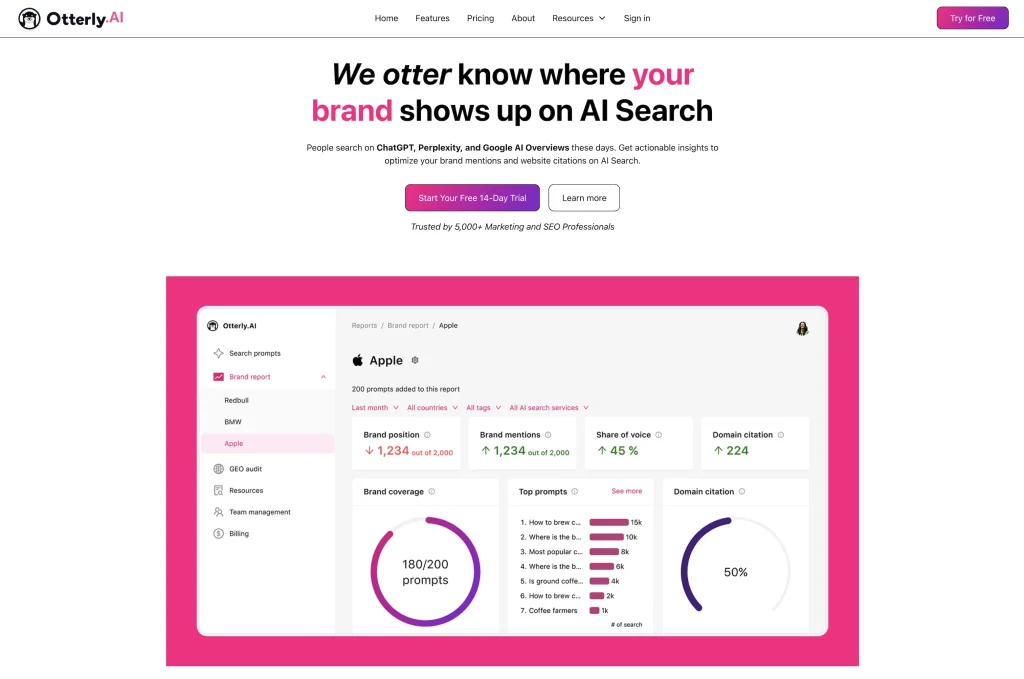
For more scalable operations, leverage dedicated AI search tracking tools like Semrush, Ahrefs, Surfer SEO, and specialized platforms designed for AI visibility. These tools monitor your brand's presence across LLMs, track metrics like average presence and visibility, and help identify optimization gaps. Most platforms offer free trials, so test 2-3 tools simultaneously with the same prompt sets to compare data accuracy, interface usability, reporting capabilities, and support quality.
Automated API Integration
The most sophisticated approach uses platforms like Make.com or Zapier to build automated workflows that continuously monitor AI search visibility. This system automatically submits prompts via APIs, captures responses, logs data in spreadsheets, and creates visualizations over time. Automated systems can generate diverse query variations, retrieve responses, log results, and trigger alerts when visibility changes significantly.
Setting Up Google Analytics 4 Tracking
Integrate GA4 to measure referral traffic from AI platforms to your website. Create a custom "Generative AI" channel group by navigating to Admin > Data Display > Channel Groups, then add a new channel called Generative AI. Use regex patterns to track traffic sources from platforms like ChatGPT and Perplexity. This connects AI visibility directly to business outcomes by monitoring bounce rates, time on page, and scroll depth.
Establishing Your Monitoring Framework
Define Your Keyword Strategy
Cluster keywords by search intent and map them to business entities. Attach business weights to each keyword based on pipeline potential, lifetime value, or strategic priority. Treat products, categories, and personas as first-class objects in your tracking system.
Select Your Tracking Scope
Your infrastructure should cover multiple surfaces: Google and Bing blue links, AI Overviews, answer engines like ChatGPT and Gemini, and social search platforms. Ensure reliable extraction of citations with domain and entity mapping, plus historical storage for trend analysis.
Implement Alert Systems
Set volatility thresholds and route alerts to the right team members when visibility changes significantly. This enables rapid response to ranking fluctuations or emerging opportunities.
Building Your Tracking Checklist
Before scaling your infrastructure, confirm these essentials are in place:
- Coverage across Google/Bing blue links and AI answers, plus at least two social-search surfaces
- Reliable citation extraction with domain and entity mapping and historical data storage
- Volatility thresholds and alerts routed to appropriate team members
- Business intelligence dashboards connecting visibility to pipeline value and customer acquisition cost/lifetime value metrics
- Content operations integration to automatically brief updates and new content creation
Scaling Your Infrastructure
Start with core monitoring before expanding. Begin with branded queries and top competitors to establish baseline measurements. Gradually add commercial and informational keywords, then scale platform coverage as you gain insights.
As you scale, connect visibility signals to revenue outcomes. Build BI dashboards that tie AI search visibility to pipeline value and business metrics. This transforms AI search tracking from a vanity metric into a revenue-driving channel.
The key to successful AI search rank tracking infrastructure is starting simple—whether through manual spreadsheets or basic tools—then evolving toward automation as your needs grow and your team gains expertise in interpreting the data.












WebSeoSG offers the highest quality website traffic services in Singapore. We provide a variety of traffic services for our clients, including website traffic, desktop traffic, mobile traffic, Google traffic, search traffic, eCommerce traffic, YouTube traffic, and TikTok traffic. Our website boasts a 100% customer satisfaction rate, so you can confidently purchase large amounts of SEO traffic online. For just 40 SGD per month, you can immediately increase website traffic, improve SEO performance, and boost sales!
Having trouble choosing a traffic package? Contact us, and our staff will assist you.
Free consultation