

You read and follow guest posting guidelines properly by treating them like a checklist and building your entire pitch and article around them—not around what you want to submit.
Below is a practical, step‑by‑step way to do it.
1. Find the right guidelines page
Most reputable sites that accept guest posts have a “Write for us” / “Guest post guidelines” page.
Look for it by:
- Searching Google for:
- “write for us + [your niche]”
- “guest post guidelines + [topic]”
- Checking the site footer and main menu (Blog → “Contribute”, “Guest posts”, etc.).
Only proceed if:
- They still accept guest posts.
- Their topics, audience, and quality match your expertise.
2. Read the guidelines slowly and turn them into a checklist
Open the guidelines page and read it fully at least twice—once for context, once to extract requirements.
Turn what you see into a clear checklist, for example:
Content & topic rules
- Allowed topics / angles?
- Topics they won’t accept? (e.g. no basic SEO 101, no crypto, etc.)
- Target audience (beginner / advanced / B2B / marketers / developers)?
Quality & originality
- 100% original, unpublished content only?
- Required depth (e.g. “definitive”, “2,000+ words”, “actionable frameworks”)?
- Non‑promotional, no sales pitches?
Formatting & structure
- Word count range (e.g. 1,500–2,500 words)?
- Required structure (H2/H3 headings, short paragraphs, bullets)?
- Image rules (who provides them, size, attribution)?
- Internal links required? How many?
- External links allowed? Any domains banned?
Links & self‑promotion
- How many links to your site are allowed?
- Where are self‑promotional links allowed (usually only in the author bio)?
- No affiliate / tracking links, if stated?
Writing style
- Tone (casual, professional, technical)?
- Region/language specifics (US/UK spelling, industry jargon)?
- Examples of “accepted” vs “rejected” topics, if given.
Submission & pitch
- Do they want:
- A topic pitch, or
- A full draft, or
- Both?
- Submission method (form / email / CMS account)?
- Required subject line or email structure?
- File format (Google Doc, Word, Markdown, in‑CMS)?
- Any banned behaviours (AI‑only content, link schemes, mass pitches, etc.)?
Tick every item off while you work.
3. Study published posts to decode the “unwritten” rules
Guidelines rarely cover everything. Before writing, open 3–5 of their most recent or most popular posts and note:
- Typical length, heading structure, and use of examples.
- How they start: story, problem, data, or definition?
- Use of screenshots, charts, or step‑by‑step instructions.
- How often they link internally and to external sources.
- How promotional they are (usually: almost not at all).
Your guest post should look and feel like “one of them”.
4. Choose and pitch topics that clearly fit their guidelines
When pitching:
-
Only propose topics that:
- Fit their audience and categories.
- Are not already covered on their blog (search their site first).
- Match their requested angles (case studies, how‑tos, data‑driven, etc.).
-
Show you read the guidelines by:
- Using their required subject line format, if specified.
- Addressing whether the topic meets their criteria (e.g. advanced, tactical, non‑promotional).
-
Personalise properly:
- Reference a specific article and insight from their blog.
- Briefly state why you’re credible for this topic (1–2 sentences).
Aligning your topic and pitch with what they’ve explicitly asked for dramatically increases acceptance.
5. Write the post exactly to spec (and non‑promotional)
While writing, keep the guidelines checklist open and enforced:
- Hit the word count range and required depth.
- Use the requested structure:
- Clear title in their style.
- Strong intro that sets expectations, not fluff.
- Logical sections with H2/H3s.
- Clear conclusion / next steps.
- Keep it non‑promotional:
- Focus on educating or helping the reader.
- Keep self‑promotion and your links in the bio, unless they allow one in‑content reference.
Also:
- Include required internal links to their content.
- Follow any SEO rules (natural keyword use, descriptive headings, etc.).
- Avoid anything they’ve banned (e.g. spun content, thin content, AI‑only text).
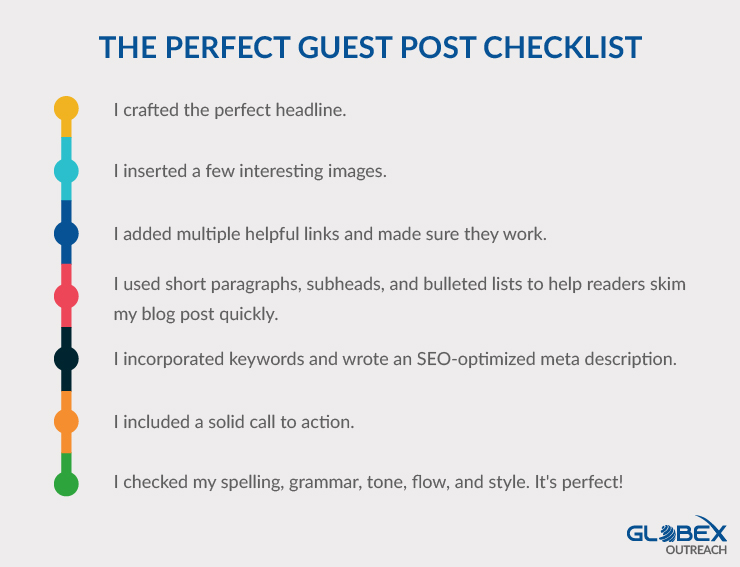
6. Format, proofread, and self‑check against the guidelines
Before sending:
-
Format for readability:
- Short paragraphs.
- Bullet points and subheadings.
- Clear, descriptive headings.
-
Proofread thoroughly:
- Fix typos, grammar, and awkward phrasing.
- Make sure links work and sources are clear.
-
Do a final guidelines compliance check:
- Are you within word count?
- All required sections included?
- Links and self‑promotion within allowed limits?
- File type / submission format correct?
Guidelines often say that poorly formatted or error‑filled posts are rejected immediately.
7. Follow their submission and follow‑up instructions exactly
When submitting:
- Use the exact channel and format they request (form, email, CMS).
- Include everything they ask for:
- Short bio.
- Headshot.
- Social profiles.
- Title ideas, meta description, etc., where required.
After submission:
- Respect their stated response time.
- Follow up only if and when their guidelines allow (e.g. after 2–3 weeks).
- Once published, promote the post and respond to comments, which many sites appreciate.
8. Quick “red flag” checks to avoid instant rejection
You likely did not read/follow guidelines properly if:
- Your topic is already covered on their blog with the same angle.
- You send a generic pitch (“I love your blog”) without site‑specific references.
- You push your product throughout the article instead of offering value.
- You break obvious rules (wrong niche, wrong word count, wrong file type, too many self‑links).
If you tell me a specific site you’re targeting (or paste their guidelines), I can turn their page into a precise checklist you can follow for your pitch and draft.
















WebSeoSG offers the highest quality website traffic services in Singapore. We provide a variety of traffic services for our clients, including website traffic, desktop traffic, mobile traffic, Google traffic, search traffic, eCommerce traffic, YouTube traffic, and TikTok traffic. Our website boasts a 100% customer satisfaction rate, so you can confidently purchase large amounts of SEO traffic online. For just 40 SGD per month, you can immediately increase website traffic, improve SEO performance, and boost sales!
Having trouble choosing a traffic package? Contact us, and our staff will assist you.
Free consultation