

A focused A/B test for Instagram Reels should pick a single primary metric to declare a “winner,” track a short list of supporting metrics, and follow an iterative cadence that turns each test result into a hypothesis for the next test. Below is a practical framework: the metrics to track, why they matter, how to measure/compare them, and how to iterate from results.
Core recommendation (1–2 sentences)
- Choose one primary metric that matches your business objective (e.g., Reach for awareness, Views or View-Through Rate for initial interest, Saves or Shares for content value, Follows or Conversion Rate for growth/ROI) and treat all other metrics as secondary signals to interpret trade‑offs.
- Run tests that isolate one variable at a time, collect enough samples for statistical significance (or at least consistent directional signals), and use secondary metrics to detect downstream effects and unintended consequences.
Which metrics to track and why
- Views (total plays): measures initial discovery and hook effectiveness for video content; useful when testing hooks, first 3 seconds, or thumbnails.
- Reach / Impressions: tells you how widely Instagram distributes the Reel (important for algorithmic virality tests) and whether a creative increases organic exposure.
- View-Through Rate (VTR) / Average Watch Time: indicates how well the Reel retains viewers past the hook; critical for Reels algorithm and for testing pacing or story structure.
- Engagement Rate (likes, comments, saves, shares relative to impressions or reach): core indicator of resonance—use as the “content effectiveness” metric when your objective is community engagement.
- Saves and Shares: high-signal engagement types that indicate perceived value and are strong predictors of future reach and algorithm preference.
- Follows (new followers attributable to the Reel): direct growth signal when your goal is audience expansion.
- Click-Through Rate (CTR) / Link conversions: for Reels that drive traffic (bio link, product page), use CTR and on-site conversion as the primary metric for performance tied to business outcomes.
- Completion Rate / % watched to end: helpful for narrative Reels or calls-to-action where full consumption matters.
- Retention curve by second: reveals exactly where viewers drop off so you can identify weak moments to fix (e.g., sinking after 3–5s).
How to pick a primary metric
- Awareness goal → Reach or Views.
- Engagement/virality goal → Engagement Rate, Saves, Shares.
- Growth/follower goal → New follows (or follows per 1k views).
- Conversion/commerce goal → CTR and on-site conversion rate.
Pick one primary metric per test to avoid conflicting winners.
How to run the test (practical steps)
- Hypothesis: write a clear, falsifiable hypothesis (e.g., “A vertical close-up hook will lift 3‑second retention by 15% vs. wide shot”). Use one hypothesis per test.
- Isolate one variable: change only one element (hook, audio, caption, hashtags, length, CTA, thumbnail) so attribution is clean.
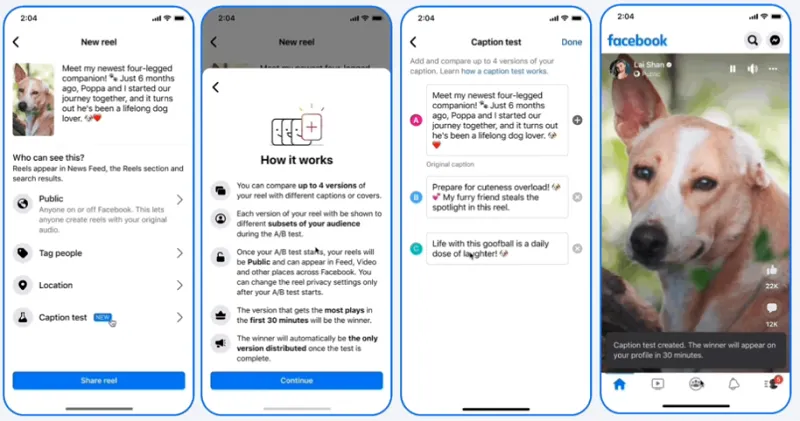
- Audience and timing: use the Trial Reels / A/B features where available (Instagram Trial Reels shows variations to non-followers) or publish variations with matched posting windows; avoid posting to the same followers simultaneously unless the platform randomises delivery.
- Sample size & duration: run long enough to gather representative data (AdWeek recommends 7–14 days for Instagram tests) and until you have enough views/interactions to judge differences.
- Primary vs secondary: evaluate the primary metric first; inspect secondary metrics for trade-offs (e.g., version A gets more views but fewer saves).
- Statistical significance: aim for clear margins or repeatable patterns across multiple tests—small differences in low volume tests are unreliable.
How to compare results and declare a winner
- Use percent change and confidence (absolute deltas matter at low volumes). Compare by the primary metric first, then check secondary metrics for alignment or conflicts.
- If A beats B on primary but B beats A on valuable secondary metric (e.g., A higher views, B higher saves), either: a) prefer the variant aligned to your objective, or b) run a follow-up test to reconcile the trade-off.
- Watch for algorithmic artifacts: a short early surge in views can bias distribution—account for initial velocity when interpreting early results.
Iteration playbook (what to test next)
- If hook loses viewers early → test new hooks (visual hook, audio cue, on-screen text in first 1–3s), then measure 3s retention and VTR.
- If reach is low but engagement high → test caption/hashtags/timing to boost discovery while preserving the creative.
- If saves/shares low but retention high → test stronger value-driven CTAs or clearer deliverables to encourage bookmarking/sharing.
- If conversions low despite traffic → test CTA placement, link clarity in bio, landing-page alignment and measure CTR → on-site conversion.
- Use iterative micro-tests (small, frequent tests of one element) to converge on winning combinations, then run a confirmatory larger test to validate at scale.
Practical tips and safeguards
- Keep tests simple: one variable, one primary metric, clear hypothesis.
- Control external factors: posting time, audience targeting and paid boosts change results—keep them constant across variants.
- Use Instagram’s built-in Trial Reels/A/B tools when possible to avoid biases from follower overlap and timing.
- Track both short-term (views, 24–72h engagement) and medium-term signals (saves, follows over 7–14 days) because Reels distribution can evolve after launch.
- Log results and insights (what was tested, metrics, interpretation) so patterns accumulate into reliable creative principles over time.
Example test matrix (quick reference)
- Variable to test: Hook → Primary metric: 3s retention / VTR → Secondary: Views, Engagement Rate.
- Variable to test: Audio (music vs. VO) → Primary metric: Views & VTR → Secondary: Saves, Shares.
- Variable to test: CTA wording → Primary metric: CTR / Conversion → Secondary: Views, Follows.
If you want, I can:
- Draft 3–5 test hypotheses tailored to your objective (awareness, growth, engagement, or conversions).
- Create a simple spreadsheet template you can use to log metrics, compute percent change, and track statistical confidence.















WebSeoSG offers the highest quality website traffic services in Singapore. We provide a variety of traffic services for our clients, including website traffic, desktop traffic, mobile traffic, Google traffic, search traffic, eCommerce traffic, YouTube traffic, and TikTok traffic. Our website boasts a 100% customer satisfaction rate, so you can confidently purchase large amounts of SEO traffic online. For just 40 SGD per month, you can immediately increase website traffic, improve SEO performance, and boost sales!
Having trouble choosing a traffic package? Contact us, and our staff will assist you.
Free consultation